
News
Plant threats - the good and bad news
Posted 20 01 2023
in News
Auckland Council has set out to establish the true extent of the diversity of local plant species, where they are actually found and the threats they are facing.
The council has led a first-of-its-kind assessment using the New Zealand Threat Classification System.
The team says it has provided a comprehensive look at the population size and trends of native species as well as identifying some of the key pressures facing them.
Councillor Richard Hills says the assessment provides valuable evidence to help Council focus on plant conservation efforts over the next few years.
“The report elevates the status of native plants in the region and supports our work in the prioritisation of threatened plant conservation. With the information we’ve gained, we’ll be able to plug the gaps in our knowledge and understand where better to focus our conservation efforts.”
A total of 787 native plant species were identified in Tāmaki Makaurau Auckland, 45 percent of which are threatened or at risk. Two hundred species have been assessed as “threatened”, 105 as “at risk”, four as non-resident native and 88 as “data deficient”. An additional 27 species were identified as having become extinct.
“As well as gaining information about many of our plants, the report has highlighted what we don’t know,” says Emma Simpkins, Auckland Council’s Senior Regional Advisor (Flora).
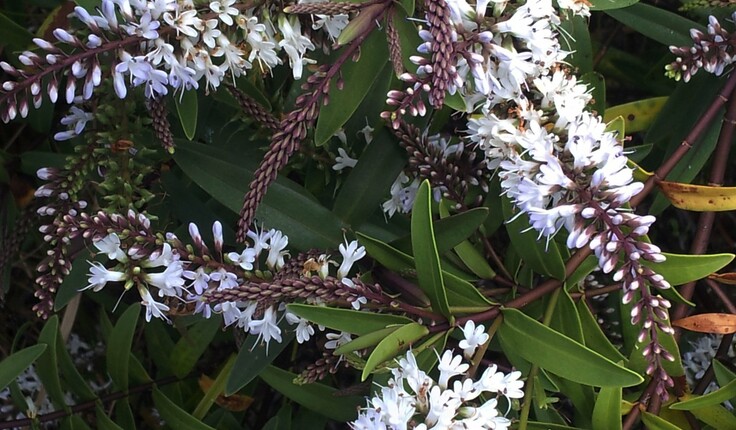
![Pomaderris hamiltonii [pale flowered kumarahou] is largely only found in the Auckland region. Image credit - Jack Hobbs.](/media/cache/ff/60/ff609656fa0d5e2b83226c09ec044c37.jpg)
“Knowing what we have, and where, is important for managing plant threats such as pathogens, weed competition, browsing by pests and what is needed to protect plant habitats,” she says.
“We’ve also highlighted many of our threatened plants don’t grow in forests, they grow in habitats with high disturbance and open areas like scrublands.”
Veronica jovellanoides is regionally critical and is mostly found in Auckland’s unique cool forest habitat. Another regionally critical species is Syzygium maire [swamp maire] which is under threat from myrtle rust.
Regionally vulnerable plants identified include Kunzea sinclairii (kānuka) which is only found in Auckland and is endemic to Aotea Great Barrier and Pomaderris hamiltonii [pale flowered kumarahou].
There is some good news though. Epilobium hirtigerum, [hairy willow herb] was previously listed as regionally “critical”, or one step below extinct and nationally “at risk” and has now been listed as “not threatened”.
“We often refer to the hairy willow herb as a plant “only its mother could love”! It’s an unpretentious plant and one species that needs disturbed ground to survive, so excavation work has done it a favour,” says Emma.
- Critical is the highest ranking under the “threatened” category of the NZ Threat Classification System
- Endangered: Euphorbia glauca (waiuatua) and Pseudopanax ferox
- At risk – declining: Metrosideros excelsa (pōhutukawa) and Ficinia spiralis (pingao)
- Vascular plants have tissue to transport water and nutrients around their systems; non-vascular do not.