
News
Member Profile
Posted 01 12 2016 by Martin Bryant
in News
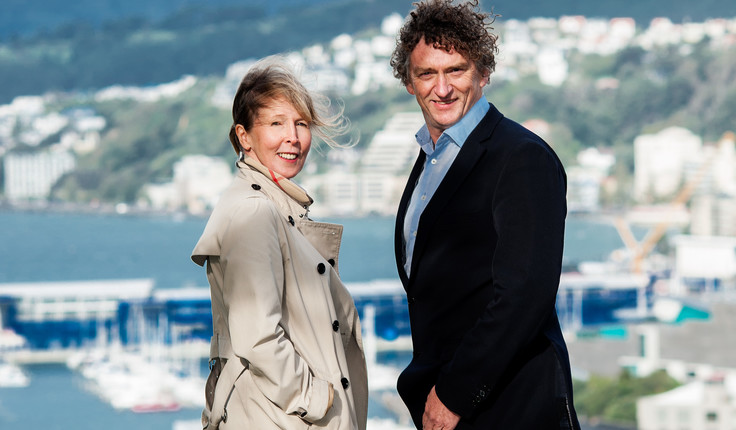
Penny Allan & Martin Bryant
Ten years ago, when lots of New Zealanders were lining up to go to Australia, Penny and I bought a one-way ticket to Wellington.
We had met on a project, called Victoria Park, at the Government Architects Office of NSW in 1999. Penny had conceived a design, which introduced wetlands into the streets and parks around high density inner-city living. I complemented her design approach - our collaboration works because we have a common goal and use our differences to achieve it. And I helped implement the project, after years of design work in Sydney's Darling Harbour in the 80s and Sydney's Olympics in the 90s. But Victoria Park was a seminal project: it benchmarked the potential of water sensitive urban design and the role of landscape architects as designers of infrastructure. It led us into other projects designing urban ecology. It led us to New Zealand in 2002 to do Wellington's Waitangi Park with Megan Wraight. And it led us to Victoria University Wellington in 2006, to research landscape concepts of urban resilience.
From a hilltop park in San Francisco we sensed how the landscape had influenced urban morphology, which had determined a network of open space, which had strengthened resilience in the city's post-1906 earthquake recovery. At the Bancroft Library at Berkeley we started joining the dots. We soon published papers about the role of open space network and its design in the resilience of cities. Different papers went to different audiences. And we spoke at lots of conferences. Conferences for engineers, for architects, for insurers, for recovery planners. Even one at the United Nations in New York.
Meanwhile Penny, then I, have led the renewal of the landscape programme at VUW. Between classes, Penny won the first NZILA Nau a Tuka award, showing the potential of design at the interface of cultures; and I played a part in the design team for the Rosa Barba winning Jellicoe precinct in Auckland and the Jump Platform in Wellington. So it's not surprising that design practice continues to shape VUW's landscape programme under our watch. Our students have now won a number of international student design awards and design competitions, demonstrating their form-making skills, and ecological-thinking skills, and strategy-building skills while addressing complex 21C landscape systems.
Penny and I are now both working on research for MBIE's Deep South, Te Komata o te Tonga project, investigating sea-level rise adaptations on Maori farmlands, which suggest, amongst other things, the value of art and design as a medium of research. And we are both completing invited design research PhDs at RMIT in Melbourne. But we always buy return tickets when we travel to Australia.